Showing posts with label culture. Show all posts

Thursday, June 4, 2015

The High Street by Alice Melvin


One of the wonderful things about living in a different country is getting to explore all the multicultural treasures found in the library. This author, Alice Melvin, is English. I have noticed a significant increase in European, Oceanic, and Asian books that have been coming home with us from our library trips, which was something I often had to scout out on my own and pray the library would accept my book-buying requests in the midwest. 


Canada is a commonwealth country, so the obvious ties with Australia and England are apparent. There are a lot of Chinese and Japanese people living in Canada, especially on the Pacific Coast where I'm at, and I see a lot of books coming from those two countries within the children's stacks. I love that! So many of the treasures I've found over the last 8 months of living 'abroad' (my American friends might laugh at that), is that the culture is very different--even down to which types of picture books get front and center in the local libraries. Books create and enhance a culture, and here it is markedly different than my American, midwestern experience. 


I picked this book up for two reasons. The first, being that I loved the modern-victorian(ish) illustrations throughout, and the second, because my daughter loves flap books. I figured even if the words weren't great, we'd still enjoy the book. I found upon our first read that yes, the story is lovely as well! It's a great book all-around. Both my children enjoyed this story and I thoroughly enjoyed the pictures of the outside of each building, along with the 'dollhouse-view' of the inside of each store. 


This story is about a little girl fetching different necessities for her basket on High Street, a main street where each little shop has what she needs...except when one doesn't!
This book is more in line with a repetitive poem, which can sometimes get unbearable to read aloud, though most children seem to like them. It's not quite the same, as the words of each item she buys are subtracted on each page until she comes to her last item. Do you know what I mean? It's not agonizing like reading aloud "We're Going on a Bear Hunt!", but there is some repetition throughout. 


On Alice's website you can peek inside and see quite a few more of the whimsical illustrations that grace the pages. This storybook is a feast for the eyes, and a fun book to read if you're a treasure-hunter, because there is so much going on visually. I've found there's even a fun paper-doll-like kit of the Emporium and a few of the characters for sale on her site. 
We had fun enjoying Melvin's story and already have a few more of her titles on hold at our local library. Cheers!

Thursday, February 5, 2015

The Man With the Violin by Kathy Stinson and Dusan Petricic


Perhaps some of you might remember when a very famous violinist participated in a social study for the Washington Post? Joshua Bell, one of the best violinists in the world performed one of the hardest violin pieces ever in a DC transit system entryway for a day, and barely anyone stopped to listen, except a handful of people. Most of them were kids! This picture book is a retelling of that story. 


A very short youtube clip can be seen HERE of Bell and his violin piece. Something fun to do after you read The Man With the Violin by Kathy Stinson and Dusan Petricic would be to listen to the piece and see how the illustrator interpreted the scratchy scales and melodramatic, flowing parts of the song. The illustrations caught my eye as I was browsing through this book at the library, and I didn't even know it was a true story until we read it in full.


I remember reading about this years ago in the news, and thought what a fun tribute to the sweet children who wanted to listen to this beautiful art coming from Bell's bow. The theme being that children, although can not articulately tell high art from play doh, they do know when art is inspiring them to keep looking, keep listening, or keep 'figuring'. This is a great title and one I think can be used well in the class or at home for exploring how art makes more art!

Thursday, January 15, 2015

Blue Birds by Caroline Starr Rose


I must admit, even as an avid reader and lover of all things wordy, I can easily be won over by a beautiful cover. "Don't judge a book by it's cover"? Psshaw. Beautiful covers have grabbed me when the name doesn't ring a bell, or the story is only a little intriguing. I'm an easy marketing target, I suppose. When Caroline Starr Rose unveiled her Blue Birds cover a few months ago, I think I made an audible sound halfway between a gasp and an "wow!". In person it's even more vibrant than the image above. So yes, the cover won me over, but the story, made completely of poems, kept me turning the pages. 


Blue Birds is a story about unlikely friendships. The story takes place in the New World, specifically, the second set of new settlers from England and the Roanoke people who already live there. Alis, the main character from the settlement, finds her new surroundings beautiful, raw, and pure, and can't get enough of the natural world. She stumbles upon a native Roanoke girl, Kimi, and they communicate together secretly through symbols, facial expressions, touch, and gifts.

Life in the New World is tough, and there are tensions between these Englishmen and women and the woodlands people, blood is shed. As readers, we are allowed into Alis's and Kimi's thoughts, and we're given insight into the cultural biases and misunderstandings. All this, and it's written in poetry. There is a quick pace to this large historical novel, and I could have read it in just one sitting if I didn't have to force myself to go to bed. The poems are accessible, and even with less detail than is normally given to a novel, the word images, plot line, climax and resolution don't miss a beat because of Rose's fine tuning. The ending even left me surprised, and that doesn't happen often with the YA fiction I've read.


The other thing I enjoyed immensely in reading Blue Birds was that I was learning something from it. As a homeschooler, I'm always on the lookout for educational materials for my kids (and myself!), and I am highly attracted to historical fiction. I am sure that I will read this novel aloud to my own children when they are a little older and happen to be studying the New World and the Pilgrims in social studies. It's a great fit: you get a glimpse of life in the early settlements, the native's clan, the natural beauty of the geography, and literature (and poetry to boot!) all rolled into one little adventure story. Blue  Birds was a treat to read and review, and I hope you'll enjoy it as well.

This post is part of a week-long celebration in honor of the book Blue Birds. Author Caroline Starr Rose is giving away a downloadable PDF of this beautiful Blue Birds quote (created by Annie Barnett of Be Small Studios) for anyone who pre-orders the book from January 12-19Simply click through to order from AmazonBarnes and NobleBooks A MillionIndieBound, or Powell's, then email a copy of your receipt tocaroline@carolinestarrrose.com by Monday, January 19. PDFs will be sent out January 20.

*I was given an advanced reader's copy of Blue Birds in exchange for a review post but the opinions of this book are my own. I signed up  because I knew I'd love the book! 

Thursday, November 27, 2014

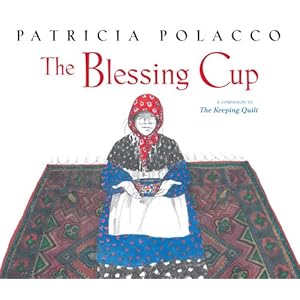
The Blessing Cup by Patricia Polacco


Happy Thanksgiving to our American readers! Today, instead of sharing a story about the Pilgrims, Native North Americans, or the very first Thanksgiving, I wanted to review a story that is all about gratitude. That's what this lovely holiday celebrates--thankfulness. The Blessing Cup by Patricia Polacco is the perfect picture book in the gratitude department. 

This book is the true story of the author's grandma Anna, when she was a little girl living in a Jewish community in Russia. Her family is content; money is tight but they have each other, and they have their community. Anna's mother's prized possession is a beautiful tea set that is worth a small fortune, given to her as a wedding gift. A prayerful tradition of thankfulness to God, and to each other for their simple life is offered up each night when the family shares tea together. 

When the Jews are expelled from Russia, Anna and her family must find refuge elsewhere, her father becomes sick. They find a doctor who is kind to them, lets the family stay in his house and nurses the father back to health. That's all I can tell you about this children's picture-book memoir without giving  the ending away. It's a beautiful story, both in illustration with black and white pencil drawings with small wisps of color, and in words.

 This book will give you a heaping dose of gratitude, and perhaps a lump in your throat towards the end. I highly recommend reading The Blessing Cup over Thanksgiving weekend, counting your own blessings, and being with those you love. 

Saturday, November 22, 2014

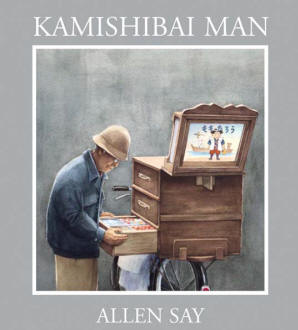
Kamishibai Man by Allen Say


When reading Allen Say's beautiful books, you can usually expect a historical and cultural lesson, and Kamishibai Man is no exception. I first caught wind of Say's work when I picked up The Bicycle Man at a library book sale, and found the book written like a child's memory from decades ago. I've been a fan of his ever since and have picked up a few more here and there, and tried to read all of his books through the library system to my kids. My two, even though they are too young to know author names, and historical nuance, are always quiet and still when listening to a Say book. It's like they sense the importance and the historical tone of the story. 

Kamishiabi Man is a story about a man who is remembering his job of Kamishibai, or the tradition of  Japanese storytelling with picture cards for emphasis. It originated before television, and was a popular way to be entertained (and perhaps then to make money by selling candy to children). The Kamishibai man takes a large wooden cupboard on his bike, stocked with the painted cards correlating to different stories, and drawers full of homemade candy. It reminded me of a theater, but instead of puppets, placards. 

A lot of Allen Say's books use very muted colors, to emphasize the story as a memory, or to put it in historical context, often dating to the second World War. Many of his stories are about Japanese traditions, folklore, or cultural references, and I love that about his books. 

*If you are interested in learning more about Kamishibai, this website might be helpful.*

Tuesday, September 2, 2014

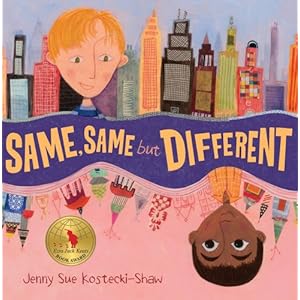
Same, Same but Different by Sue Kostecki-Shaw

Same, Same but Different, by Jenny Sue Kostecki-Shaw

"Same, Same, but Different," by Jenny Sue Kostecki-Shaw tells the story about pen pals, one from a big city in the USA and the other from India. They describe their families, pets, homes, etc. to each other through their letters and drawings to each other. An example of their correspondence is when the boy from the United States writes about busy streets where he lives, with drawings of traffic-crowded streets. The boy from India responds by noting that they don't have many cars, but he still has busy streets and his drawings show streets full of carts, cars, elephants and pedestrians. Same, same but different.

I read this book with my daughter as we started writing to our new pen pals. We have friends and cousins in opposite ends of the country, and this book was an excellent example of how people across the globe, or even our country live lives that are 'same, same, but different.'

This is an excellent book to introduce diversity, geography and starting a pen pal with someone new.

Thursday, August 28, 2014

Good Masters! Sweet Ladies! Voices from a Medieval Village by Laura Amy Schlitz

via

This review is for the older kid, or the person who loves history and historical fiction. Although I'm reading this to my kids for part of their history homeschooling curriculum, it is a bit over their head. They are missing a lot, but they are catching some of it.

So while this children's book review might be for the older crowd, I wanted to share it because it is a gem. It won the Newberry award, and it is set up like a play. There are twenty-some 'voices' in this village that have speaking parts, so essentially an entire class could put this on and everyone would have a part. There are a few 'historical tidbit' pages interspersed throughout the pages, too, to give the reader background.

Every 'voice' is actually written in poetry. Readers can catch so much history from the richness of the language, the specific names used (many I'd never heard of before, and couldn't tell whether which gender they were for without help from the photo and the audio recording of the book), the descriptions of the jobs, and of course, the development of the relationships that these people shared living their everyday lives. We found out who was despised, how these people got by by tricking their lords (who they rented their property from), and how usually even one or two animals was the difference between shoes, a full belly, and a manageable livelihood.

I would highly recommend listening to the audio of this book while going through the poems, because each poem/person has a distinct voice and I feel the book has greater value when it's enhanced in this way. Listeners can focus on all the little details when they can just listen, instead of focusing on reading and understanding the old English (with puns) and correctly pronouncing the words.

I think this would be a great read-aloud for school curriculum when studying the middle ages, and it really can go along with history and language arts really well. While geared towards children say, 8 and above, my younger ones have been enjoying the story in bits and pieces (maybe 3 'voices') in the car with the audio reading to them.

Tuesday, July 8, 2014

Fun YA Fiction and a Newberry to Book: Flora & Ulysses


Holy Bagumba!

The cover of Flora & Ulysses by Kate DiCamillo had been haunting me at the library. There were four or five copies of the Newberry winner with all types of stickers on the cover, and a few facing out on the shelf. I thought the illustrations were lovely in an oddball sort of way, but the first time I flipped through it I noticed it was part story, part comic book.

Eh. Comics. I read enough of them to the kids to know it's not my preferred style. I set it back down and we were on our way. I think I did this three times in three weeks before I just tossed it in my bag to see what would come of it.

When I started it, I couldn't believe how hilarious DiCamillo's characters were, and I realized, oh yeah, I have one of her other well-known books on my shelf, that I read when I was a kid, Because of Winn-Dixie. She also wrote the acclaimed Tale of Despereaux, which I had planned on reading to the kids this summer. Well, after the first 30 pages or so, that went lickety-split because of the 1-3 page chapters, I was hooked.

This story has a random plot-line and a rag-tag bunch of characters. First, a superhero squirrel who was sucked into a vacuum and lived to tell (write) about the tale in poetic form, a boy who became blind by trauma (maybe, maybe not), and Flora, the young cynic whose parents are separating. Kate DiCamillo marries laughter, wonder, observation, preparedness, comic boxes, and quirky humor into a great book.  I'm not sure how DiCamillo was able to take this lunchroom soup mix and write about divorce, hope, friendship, and love, but she did. Your kids will enjoy it, but you will, too.

Monday, June 9, 2014

Queen Victoria's Bathing Machine by Gloria Whelan

photo credit

With a beautiful cover like this, how can you not pick it up? This book struck me first with the lovely illustration, second by the historical nature of the story. I knew from the title our family was in for  a rich lesson, and more than a little humor, as well. This storybook did not disappoint. I loved it.

Queen Victoria's dilemma-- thick petticoats, hot summer temperatures, and traditions of the monarchy-- combines into a playful and educational storyline, written in verse. Children from ages 3-12 could really enjoy this story, which is hard to achieve in a picture book. Young ones tack onto rhyme and meter, and the older crowd will be fascinated by this true story of invention, and royalty from another time and place. 

The illustrations are done by Nancy Carpenter, and I'm already going to track down all of her other illustrated books, because Bathing Machine is just beautiful. It has a somber and muted palette, with very scritch-scratchy pen drawing with watercolor atop. It truly is modern with Victorian overtones. The illustrations are synced well with the storyline, and captures the playful and inventive spirit of the story.

Learn about the historical bathing machine, created in 1846 by Victoria's husband Prince Albert in the back of the book, see a photograph of the machine, on display in England, and gather info for more study on the websites and further bibliography provided. Truly a crown jewel on the shelf! 

Sunday, July 14, 2013

The Three Questions: Based on a Story by Leo Tolstoy by Jon Muth

photocredit

I love unexpected treasures found in the form of books in our local children's section at the library. After we gather our heavy weekly collection, some chosen by my children, some by myself, we haul our sturdy wool library bag over to the self-checkout and line up our cards. The majority of the time we haven't read any of the titles in our bag, but the gems are still quietly lined up waiting to be seen and heard aloud. 

This book, The Three Questions, was one I had picked up because I thought the cover looked thoughtful, and I was intrigued by the subtitle which is "Based on a story by Leo Tolstoy". Leo Tolstoy is a famous Russian writer who is known for his gigantic books like "Anna Karenina" and "War and Peace". His books are classic stories of the human condition, and I really wondered how a children's book was going to turn out with a subtitle like that!  

The story is quiet and somber in tone and a very philosophical book for young children. As I read it to my own kids, I don't know that they had a good grip on the ending moral of the story, but I certainly thought it was a very worthwhile book. I hadn't even noticed who the author was before I started reading it, but Jon Muth is the author and illustrator behind the Zen Shorts collection, which are also beautiful, bright in color, and have excellent side-stories to help children understand emotion and challenging concepts. The Three Questions no doubt aligns itself perfectly on the shelf next to these books. 

The plot is simple and fluid, whereas a young boy, Nikolai asks three very challenging questions to his friends Dog, Monkey, and Heron. His questions, to become a better person, are the following: "When is the best time to do things?; Who is the most important one?; What is the right thing to do?". His three friends answer these questions in very different ways, each with their own personality bent. He finally finds his answer by talking to tortoise, and taking action with a panda family. A valuable lesson is learned by Nikolai and the listeners alike, as we realize we make things harder than they need to be. This beautiful book, illustrated with water colors throughout, is definitely worthy of your next stop at the library.